Back to blog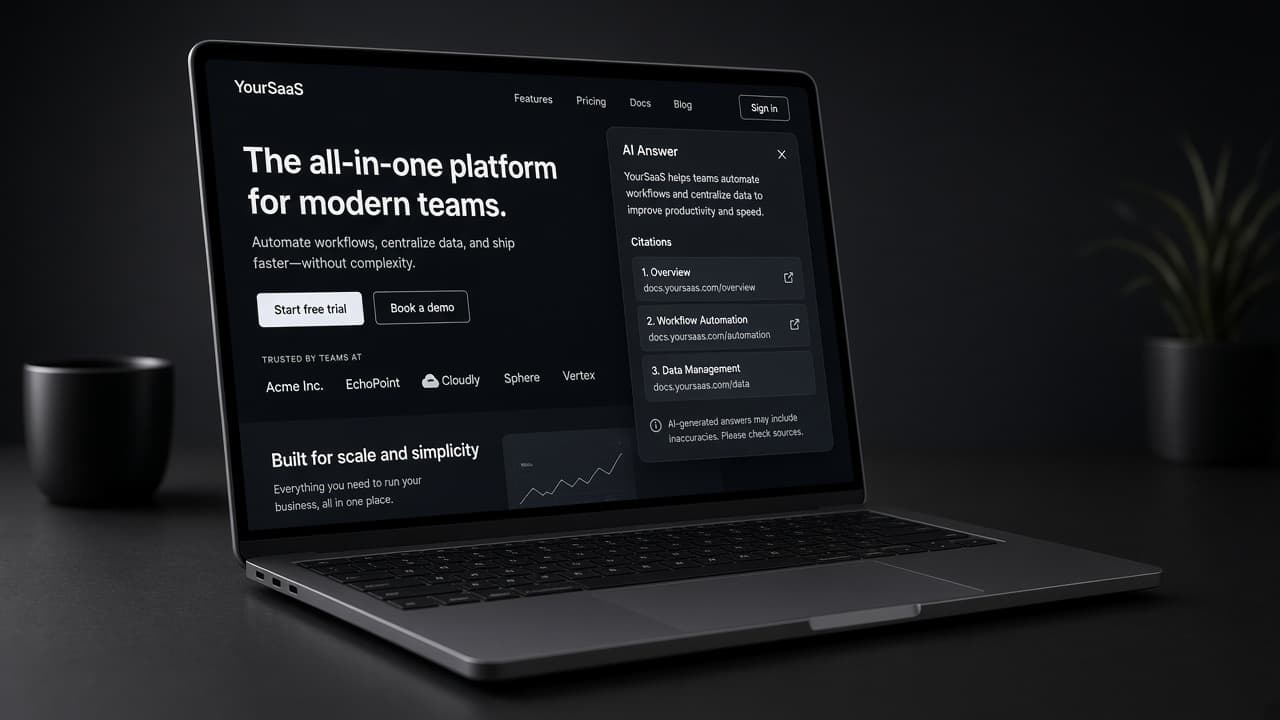
SEO vs AEO priorities for early SaaS
11 min read
Answer Engine Optimization for SaaS: Get Your Product Cited in AI Answers
Practical answer engine optimization for SaaS landing and product pages: structured answers, llms.txt, citations, and how AEO differs from classic SEO for startups.
Answer engine optimization for SaaS is a distribution channel now
Search behavior split in 2025–2026. Buyers still Google—but they also ask ChatGPT, Perplexity, Gemini, and Copilot what to buy, how tools compare, and which vendor fits a constraint. If your SaaS is absent from those answers, you are invisible in a growing slice of discovery.
Answer engine optimization for SaaS is the practice of making your product facts easy for AI systems to retrieve, quote, and attribute. It is related to SEO but not identical. SEO optimizes for ranked links. AEO optimizes for cited sentences, structured comparisons, and accurate feature lists inside an answer.
Startups feel this first in eval cycles. Prospects arrive with AI-generated shortlists that omit you—not because your product is weak, but because your site speaks in marketing fog while competitors publish crisp definitions, pricing facts, integration lists, and comparison tables models can parse.
This guide covers AEO vs SEO for startups, how to get cited in AI answers with landing and product page structure, a practical SaaS llms.txt guide, generative engine optimization SaaS tactics for documentation and changelogs, and lightweight measurement so you know if it is working.
You do not need a new team. You need clearer pages, machine-readable summaries, and the same discipline you apply to activation metrics—applied to how machines describe you. Founders shipping B2B SaaS in 2026 should treat this as a product decision with measurable outcomes, not a branding exercise. Prototype the smallest slice that proves the pattern, instrument hesitation and completion, and iterate on copy and placement before expanding scope. Teams that skip this discipline often ship polished demos that fail in week-two retention because the interaction model never matched the job.
AEO vs SEO for startups: same site, different jobs
SEO and AEO share foundations: fast pages, clear headings, authoritative content, internal links. They diverge in what success looks like. SEO chases clicks from SERPs. AEO chases accurate mentions and citations when a model synthesizes an answer—even if the user never visits your homepage that session.
For startups, that difference changes prioritization. Classic SEO might push long-tail blog volume. AEO pushes definitional clarity on money pages: what the product is, who it is for, pricing model, limits, integrations, security posture, and how you differ on one axis that matters.
Keyword stuffing hurts both; vague thought leadership hurts AEO more. Models quote concrete sentences. "We empower synergistic workflows" becomes nothing. "We help B2B support teams deflect repetitive tickets with a copilot that drafts replies from your help center" becomes citable.
Technical overlap includes schema markup, clean HTML headings, and stable URLs. AEO-specific additions include llms.txt, explicit FAQ blocks with direct answers, comparison tables with named competitors, and changelogs models can time-anchor.
Resource allocation for a five-person startup: keep core SEO hygiene, then spend the next content sprint rewriting homepage and docs opening sections for answer clarity before chasing thirty blog posts. Founders shipping B2B SaaS in 2026 should treat this as a product decision with measurable outcomes, not a branding exercise. Prototype the smallest slice that proves the pattern, instrument hesitation and completion, and iterate on copy and placement before expanding scope. Teams that skip this discipline often ship polished demos that fail in week-two retention because the interaction model never matched the job.
| Dimension | SEO emphasis | AEO emphasis |
|---|---|---|
| Primary win | Ranked click from search | Accurate citation in AI answer |
| Hero page job | Convert visitor | Define product in quotable sentences |
| Content shape | Depth + backlinks | Structured facts + comparisons |
| Technical | Core vitals, sitemap | llms.txt, schema, stable anchors |
| Measurement | Impressions, CTR | Brand mentions in AI audits, citation checks |
How to get cited in AI answers with structured landing pages
Models cite pages that reduce their work. Structure is generosity to the machine and clarity to humans.
Lead each major section with a direct answer sentence before elaboration. Under "Who is it for?" start with "Acme is for B2B SaaS support teams with 5–200 agents handling email and chat." Under "Pricing" state model, starting price, and what scales cost—not "Contact us" alone.
Use predictable heading hierarchy: one H1, question-shaped H2s, short paragraphs, bullet lists for features with parallel grammar. Tables beat prose for comparisons. Name competitors honestly where legal; models and buyers trust specificity.
Add an evidence block on product pages: founding year, customer count band, compliance badges, key integrations, uptime or security page links. Evidence blocks are not bragging—they are anchors models attach to claims.
Avoid embedding critical facts only in hero animations or image text. OCR is inconsistent; HTML text is reliable. Captions under product screenshots should restate the feature in words, not only labels inside the image.
Internal linking matters: link from blog posts to definitive pages for terms you own. If every post defines "agentic support" differently, models pick whichever competitor wrote the cleanest single paragraph.
Refresh money pages when positioning shifts. Stale pricing and retired features propagate into AI answers long after your sales team corrected them on calls. Founders shipping B2B SaaS in 2026 should treat this as a product decision with measurable outcomes, not a branding exercise. Prototype the smallest slice that proves the pattern, instrument hesitation and completion, and iterate on copy and placement before expanding scope. Teams that skip this discipline often ship polished demos that fail in week-two retention because the interaction model never matched the job.
SaaS llms.txt guide: machine-readable product facts
llms.txt is a convention for publishing a concise, markdown-friendly summary crawlers and tools can fetch at /llms.txt. Think robots.txt meets README for models.
A practical SaaS llms.txt guide includes: product name and one-sentence definition, primary personas, core jobs, pricing summary, integrations list, security and compliance links, support channels, changelog URL, and explicit "do not claim" boundaries if models hallucinate features you lack.
Keep it under two thousand words. Link to canonical pages for depth rather than duplicating entire docs. Update llms.txt when you ship pricing changes, rename modules, or deprecate integrations—models lag reality if you lag documentation.
Place human-readable parity on the site: llms.txt should not contradict the homepage. Discrepancies erode trust when a prospect compares AI answer to your site.
Technical placement: serve as plain text at root, cache reasonably, include Last-Updated date in comment header. Some teams mirror key sections in structured JSON alongside for internal tools.
llms.txt is not a replacement for good HTML. It is an index of truths. Weak products cannot SEO their way out; neither can they llms.txt their way out. But strong products with vague pages lose citations to weaker products with sharp ones.
Pair llms.txt with a short /for-ai or /facts page for humans who hear about you from an assistant and want verification quickly. Founders shipping B2B SaaS in 2026 should treat this as a product decision with measurable outcomes, not a branding exercise. Prototype the smallest slice that proves the pattern, instrument hesitation and completion, and iterate on copy and placement before expanding scope. Teams that skip this discipline often ship polished demos that fail in week-two retention because the interaction model never matched the job.
Generative engine optimization SaaS beyond the homepage
Generative engine optimization SaaS work extends to docs, API references, changelogs, and comparison pages—not only marketing hero copy.
Documentation opening paragraphs should answer "what does this API do" in one line before parameters. Changelogs should use dated entries with explicit added, changed, fixed, removed sections—models time-travel poorly when changelogs are vague "improvements."
Comparison pages are AEO gold when honest. Compare on dimensions buyers ask AI: deployment model, pricing unit, key integrations, data residency, free tier limits. A table with checkmarks beats a thousand words of adjectives.
Case studies help when they include quantified outcomes in the first paragraph: "Reduced ticket handle time 22% in 90 days" is citable; "transformed their support journey" is not.
Glossary pages define terms you want to own: "intent-based UX," "human-in-the-loop approval," "answer engine optimization." Each entry is one tight definition plus link to product relevance. Glossaries reduce model confusion when your category is noisy.
Developer-facing SaaS should publish OpenAPI summaries and example requests in HTML text, not only interactive explorers behind JS. Models and search crawlers both reward visible examples.
Marketing and product marketing must sync quarterly on canonical phrasing. One vocabulary across site, docs, sales deck, and llms.txt beats creative rewrites per channel. Founders shipping B2B SaaS in 2026 should treat this as a product decision with measurable outcomes, not a branding exercise. Prototype the smallest slice that proves the pattern, instrument hesitation and completion, and iterate on copy and placement before expanding scope. Teams that skip this discipline often ship polished demos that fail in week-two retention because the interaction model never matched the job.
Citations, evidence, and comparison integrity
Getting cited is step one. Staying cited requires integrity. Models amplify whatever is easiest to quote; if you exaggerate, you train bad answers that hurt sales calls.
Cite primary sources on your own site: link security whitepapers, SOC reports, status page, public pricing. When you claim integration, link to the integration doc with setup steps—not a logo wall alone.
Name limits plainly: seat minimums, API rate caps, regions supported, features on higher tiers. Omissions become hallucinations filled by competitors.
Comparison pages should include "last reviewed" dates and footnotes when a competitor changed pricing. Ethical AEO is not attack SEO—it is accurate positioning. Acknowledge where rivals win on one axis; claim where you win on yours.
User-generated content matters cautiously. G2 and community threads influence models but you control less. Ensure your official pages are sharper so third-party noise is not the only source.
When models misquote you, fix the page they likely ingested, update llms.txt, publish a changelog note. Retrain internal sales with the corrected phrasing. AEO is iterative maintenance, not a launch-day task.
Legal review for comparisons is worth the delay. One inaccurate competitor claim can become a permanent AI answer about you both. Founders shipping B2B SaaS in 2026 should treat this as a product decision with measurable outcomes, not a branding exercise. Prototype the smallest slice that proves the pattern, instrument hesitation and completion, and iterate on copy and placement before expanding scope. Teams that skip this discipline often ship polished demos that fail in week-two retention because the interaction model never matched the job.
Measure whether AEO is working
AEO measurement is immature but usable. Combine manual audits with traffic signals.
Monthly, run ten buyer prompts in major assistants: "best [category] for [persona]," "compare [you] vs [competitor]," "pricing for [product type]." Log whether you are mentioned, quoted accurately, linked, or omitted. Track trend, not single runs.
Monitor referral traffic from AI products where analytics expose it. Watch branded search lift after category campaigns. Spike in "I saw you mentioned in ChatGPT" on demo forms is qualitative gold—codify it in CRM picklists.
Site-side: track scroll depth on FAQ and comparison pages, copy events on "facts" blocks, and search queries on docs indicating definitional confusion.
SEO tools adding AI visibility scores can inform but do not outsource judgment. Validate with human read of answers—models paraphrase.
Set realistic expectations. AEO compounds like SEO. A sprint rewriting homepage and llms.txt may show citation movement in weeks; category ownership takes quarters.
Share results with product marketing and design. If models describe your UI wrong, fix screenshots and feature names on product pages—not only blog tone. Founders shipping B2B SaaS in 2026 should treat this as a product decision with measurable outcomes, not a branding exercise. Prototype the smallest slice that proves the pattern, instrument hesitation and completion, and iterate on copy and placement before expanding scope. Teams that skip this discipline often ship polished demos that fail in week-two retention because the interaction model never matched the job.
A practical four-week AEO rollout for lean teams
Week 1: Audit homepage, pricing, and top three docs pages for quotable first sentences. List contradictions. Assign one owner for canonical phrasing.
Week 2: Rewrite H2 sections as question + direct answer. Add one honest comparison table. Publish llms.txt and /facts page.
Week 3: Add schema where appropriate—Organization, SoftwareApplication, FAQPage. Ensure critical text is HTML, not image-only.
Week 4: Run first AI citation audit. Fix top three inaccuracies on site. Brief sales on new canonical definitions.
Ongoing: tie changelog entries to llms.txt updates; review comparison pages quarterly; add one glossary term when you ship a new category phrase.
Founders building with a design partner should include AEO in landing page scope—not as an SEO afterthought. Structure, typography, and information architecture determine whether facts are visible to machines and humans alike.
Answer engine optimization for SaaS is defensible moat when your product is strong and your words are precise. Vague greatness stays invisible; clear specificity gets quoted.
Related articles
11 min read
Design Systems for AI Features: Primitives, Review States, and Shipping Velocity
AI features ship faster when design systems define the review contract first—primitives, tokens, and states—not when every squad invents its own sparkle button.
11 min read
Progressive Disclosure in SaaS UX: How to Hide Complexity Without Hiding Value
Complex SaaS does not need a simpler product—it needs a smarter sequence. Progressive disclosure shows power without dumping every toggle on day one.